
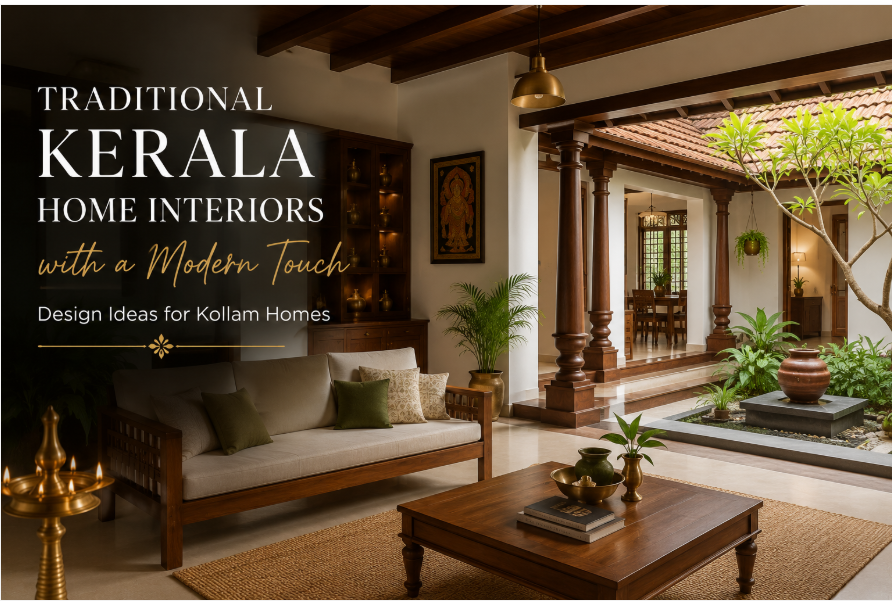
Traditional Kerala Home Interiors with a Modern Touch: Design Ideas for Kollam Homes
Bringing traditional Kerala design into a modern Kollam home doesn’t require rebuilding a full tharavadu-style house most of the effect comes from a handful of well-chosen structural or accent elements, not a total reconstruction. Wood tones, a courtyard-inspired feature, brass accents, and natural textures can sit comfortably alongside a fully modern layout, modular kitchen, and contemporary furniture. The real decisions aren’t about which elements look traditional every list online covers that they’re about what’s realistic for your home’s structure, what holds up in Kollam’s climate, and what actually costs more for a similar look.

What “Traditional Kerala Style” Actually Means
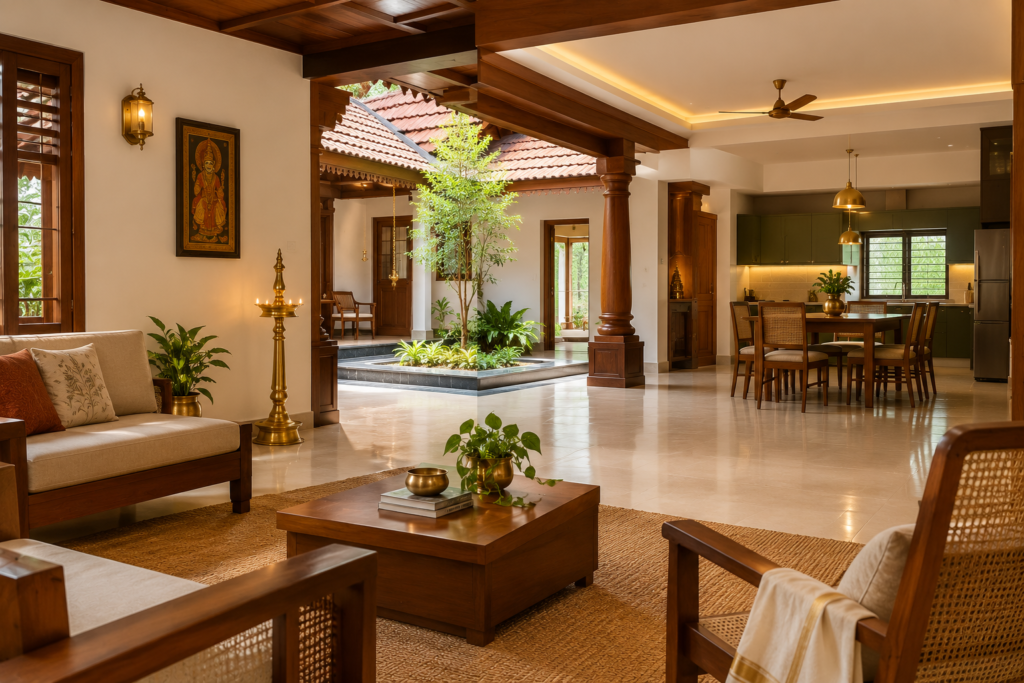
Kerala’s traditional Tharavadu homes were built around a few consistent ideas: sloping tiled roofs for rain runoff, a central open courtyard (nadumuttam) for light and airflow, thick laterite or wood walls for natural cooling, and heavy use of solid teak or jackfruit wood in pillars, doors, and furniture. Brass items (nilavilakku lamps, vessels), kasavu fabric accents, and mural-style art rounded out the decor. Nearly every home-design resource covering this topic lists these same elements — the more useful question for a Kollam homeowner today is which of these can realistically be brought into a modern home, and how.
The Decision Framework: Accent vs Structural
The single biggest factor in how much traditional design you can incorporate is whether you’re building new or working within an existing structure:
| Element | New Construction | Existing Home Renovation |
|---|---|---|
| Sloping roof | Fully achievable, planned from the architectural stage | Rarely feasible without major structural rework — usually not worth pursuing |
| Nadumuttam-style courtyard | Achievable with proper structural planning | Only possible if there’s already an open central space to work with; can’t typically be added |
| Laterite or exposed stone walls | Can be built as structural walls or applied as a feature cladding | Feature cladding on an existing wall is the realistic option, not structural laterite blocks |
| Solid wood pillars/ceiling beams | Structural or decorative, both possible | Decorative wood cladding on existing columns/ceiling, not new structural beams |
| Brass accents, lamps, vessels | Fully flexible | Fully flexible |
| Kasavu fabric, mural art, wooden furniture | Fully flexible | Fully flexible |
The pattern is consistent: anything involving the building’s actual structure (roofline, courtyard, structural walls) needs to be part of new construction or a major structural renovation which is architect-led work, not something an interior designer alone should attempt. Anything decorative or furnishing-based (wood cladding, brass accents, fabric, art, furniture) can be added to almost any existing home regardless of when it was built. If you’re not sure which category your specific idea falls into, it’s worth understanding when a project needs an architect rather than an interior designer before getting attached to a particular structural feature.
A Failure Mode Worth Naming: When “Traditional Materials” Don’t Behave Like the Originals
This is a common source of disappointment: homeowners choose decorative laterite-look cladding tiles or untreated solid wood accents expecting them to perform like the traditional full laterite-block walls or properly seasoned structural timber used in older Tharavadu homes. They don’t. Thin cladding doesn’t provide the same thermal insulation as a solid laterite wall, and decorative wood elements that aren’t properly treated for humidity can warp, crack, or develop mold within a couple of monsoon seasons — a risk that’s higher in Kollam’s coastal and backwater-adjacent pockets than in drier inland areas. This isn’t a reason to avoid these materials; it’s a reason to treat them as what they are (a visual reference to tradition, not a structural replacement) and to insist on proper sealing and treatment regardless of which material you choose. The same humidity logic that affects plywood and cabinetry near the backwaters applies just as much to natural wood and stone finishes.
A Contrarian Note: You Don’t Need the Full Tharavadu Look
There’s a common assumption that “authentic” Kerala-style interiors require committing fully — sloping roofs, courtyards, solid wood everywhere. In practice, a handful of well-placed elements usually delivers most of the emotional and visual effect: a wood-clad feature wall, a single striking brass lamp, a courtyard-inspired skylight or indoor plant nook instead of a full nadumuttam, and one or two solid wood furniture pieces. Homeowners who try to do everything at once often end up with a heavier, more expensive result than one built around a few intentional choices. Restraint, not completeness, is usually what makes these interiors feel authentic rather than themed.
Room-by-Room: Where This Works Best
Living Room: The easiest room to blend both styles a wood-toned TV unit or ceiling detail, a single traditional furniture piece (a wooden bench or chair), and brass accent lighting go a long way without touching the room’s structure.
Kitchen: Where Tradition Meets Daily Function
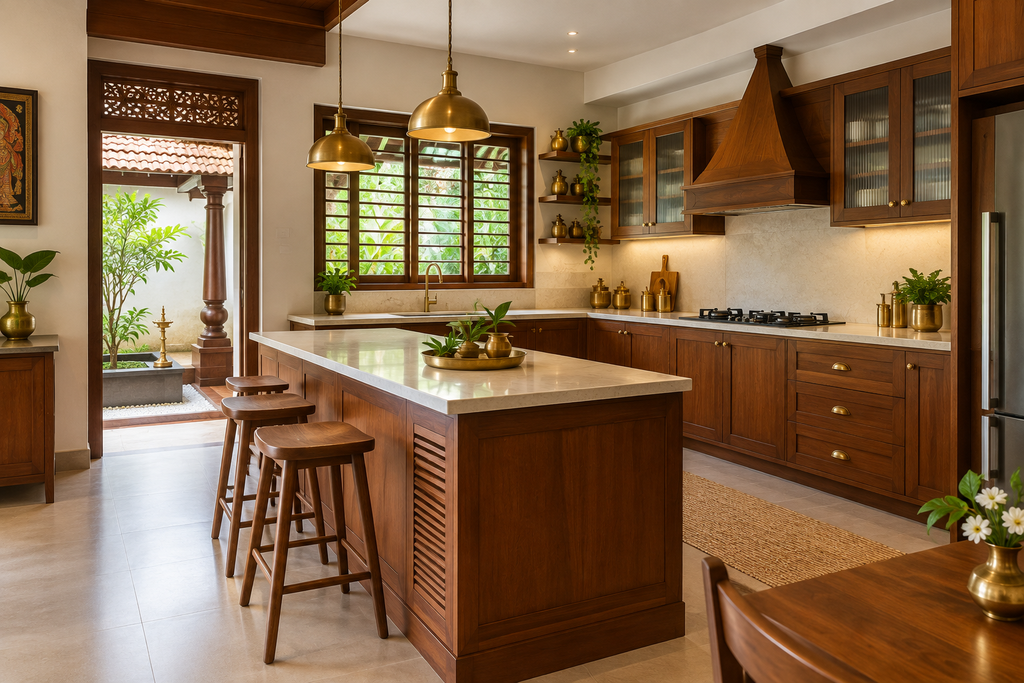
A fully modern, functional kitchen and a traditional aesthetic aren’t at odds — warm wood-finish cabinetry, brass or antique-brass hardware, and a terracotta or earthy-toned backsplash can sit inside an entirely modern, ergonomic layout. This is worth planning specifically at the material-selection stage rather than as an afterthought, which is exactly the kind of decision covered in more depth for modular kitchen design in Kollam.
Bedrooms: Solid wood bed frames, muted earthy wall tones, and simple woven textiles work well without needing any structural change.
Pooja/Prayer Spaces: Almost always achievable as a dedicated nook with wood detailing, stone texture, and brass elements, regardless of whether the rest of the home leans modern or traditional. This is also a space where Vastu considerations often come up specifically, which is worth planning for directly rather than assuming any nook placement works equally well.
How We Assess What’s Realistic During a Site Visit
Before recommending specific traditional elements, a site visit looks at three things: whether the existing structure has any usable open space for a courtyard-style feature, the condition and orientation of existing walls (to judge whether cladding or structural work applies), and ventilation patterns that affect how natural materials will hold up over time. This is the same site-assessment logic that applies to material choices across different parts of Kollam district location and existing structure decide what’s realistic far more than personal preference alone.
[INSERT: Optional SME quote — 1-2 sentences from your design team on a real project where a client wanted a specific traditional element and how it was adapted to the actual structure. Not required, but adds a genuine voice if available.]
What This Costs Compared to a Fully Modern Interior
Traditional accents don’t have to significantly increase your budget — brass fixtures, wood-tone laminate (versus solid wood), and a single feature wall are comparable in cost to any other design choice at a similar quality tier. Where costs rise meaningfully is when solid wood, real laterite, or structural elements like a genuine courtyard are involved, since these use more material and, in the case of structural changes, involve architectural planning. If budget is a primary concern, our broader interior design cost guide for Kollam breaks down what drives pricing up or down across material choices generally.
Frequently Asked Questions
Can I add traditional Kerala elements to an existing modern home without major renovation?
Yes, for most decorative elements. Wood-tone cladding, brass accents, textiles, and furniture can be added to almost any existing home. Structural elements like a nadumuttam-style courtyard or a sloping roof typically can’t be added without major renovation or aren’t feasible at all in an existing structure.
Does traditional Kerala interior design cost more than a fully modern interior?
Not necessarily. Accent-level traditional elements like brass fixtures and wood-tone laminate cost about the same as comparable modern finishes. Costs rise mainly when solid wood, real laterite, or structural features are involved, since these require more material and sometimes architectural planning.
Is decorative laterite cladding as durable as traditional laterite block walls?
No. Decorative laterite-look cladding provides a similar visual texture but doesn’t offer the same thermal insulation as solid laterite block walls, and it should be treated as a design finish rather than a structural or climate-control material.
Do I need an architect to add traditional design elements to my home?
Only if the element involves the building’s structure, such as a courtyard, sloping roofline, or structural walls. Decorative elements like wood cladding, brass accents, and traditional furniture can typically be planned and installed by an interior designer without architectural involvement.
How do I prevent wood and natural materials from warping in Kollam’s climate?
Proper treatment and sealing matter more than the material choice itself. Wood and natural stone finishes should be treated for humidity resistance regardless of whether the home is in a coastal, backwater-adjacent, or inland area, since untreated materials can warp or develop mold within a couple of monsoon seasons.
Can a small apartment in Kollam incorporate traditional Kerala design elements?
Yes. Since most traditional design impact comes from accents rather than structural features, apartments can incorporate wood tones, brass accents, and traditional furniture pieces just as effectively as independent homes, without needing space for a courtyard or sloping roof.
Want a Home That Feels Rooted, Not Themed?
The difference between an interior that feels genuinely connected to Kerala’s design heritage and one that feels like a themed replica usually comes down to a few well-chosen, well-executed elements rather than an attempt to recreate everything at once.
Talk to Nila Interiors about which traditional elements actually make sense for your home’s structure and budget — part of what’s covered in any interior design consultation in Kollam.