
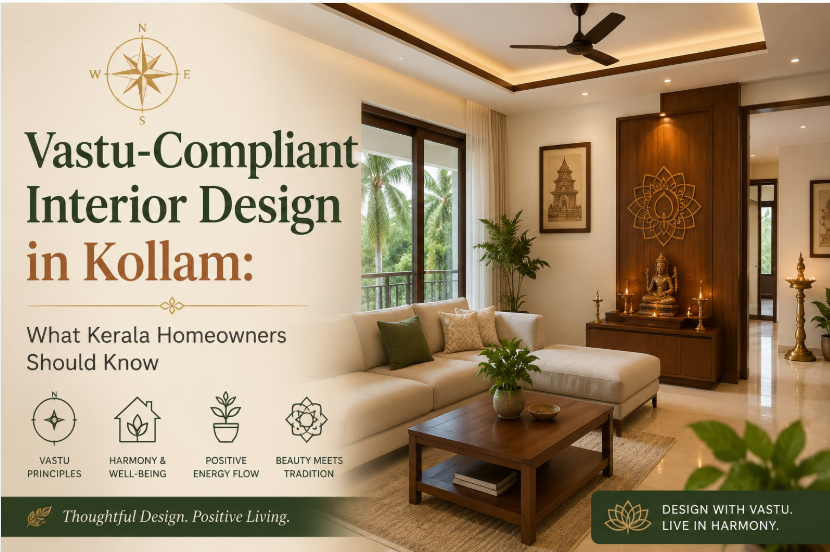
Vastu-Compliant Interior Design in Kollam: What Kerala Homeowners Should Know
Ask any homeowner in Kollam what mattered most while planning their house, and somewhere between the budget and the tile selection, Vastu comes up. In Kerala, a state where the nalukettu and ettukettu courtyard homes were built almost entirely around directional logic, Vastu Shastra isn’t a fringe belief. It’s a quiet, non-negotiable checklist that runs alongside every serious home-building or renovation conversation, from Chinnakada to Karunagappally.
Yet most interior design content written for Kollam only talks about cost, modular kitchens, and finishes. Almost nobody explains how Vastu principles actually apply to interior design — not construction — which is the part homeowners can still control even after the walls are already up. That’s the gap this guide fills.
What Vastu Shastra Actually Means for Interiors (Not Just Construction)
Vastu Shastra is the ancient Indian science of architecture that aligns a building with the five natural elements, Prithvi (earth), Jal (water), Agni (fire), Vayu (air), and Akash (space), and the eight directions, or ashtadikpalakas. Vastu is often assumed to be only about plot shape and wall placement, decided at the construction stage. In reality, a large part of Vastu compliance happens at the interior design stage: furniture placement, colour choices, mirror positioning, lighting direction, and even where you place a water feature or a plant.
This matters because most homeowners approach Nila Interiors an professional interiors designers in kollam cafter the structure already exists, meaning the direction of the kitchen or the main door is fixed. Interior design is where Vastu balance is actually recovered or reinforced, room by room.
Why Vastu Still Shapes Home Decisions in Kollam and Kerala
A few reasons Vastu carries more weight here than in many other regions:
- Cultural continuity — Kerala’s traditional homestead architecture was Vastu-first by design, and that inheritance still influences what feels “right” to homeowners today, even in modern apartments.
- Resale and rental confidence — Vastu-compliant layouts are frequently listed as a selling point in Kollam’s residential property market, alongside plot facing and proximity to the town.
- Family decision-making — In most Kollam households, the final sign-off on a design plan often comes from elders who specifically check directional placement of the kitchen, pooja room, and main entrance before approving anything.
- Peace of mind over superstition — For many clients, it’s less about ritual and more about a layout that simply “feels balanced” — enough natural light, clutter kept out of high-traffic corners, and a kitchen that doesn’t feel cramped or dark.
Vastu-Compliant Interior Design: A Room-by-Room Guide
Main Door and Entrance
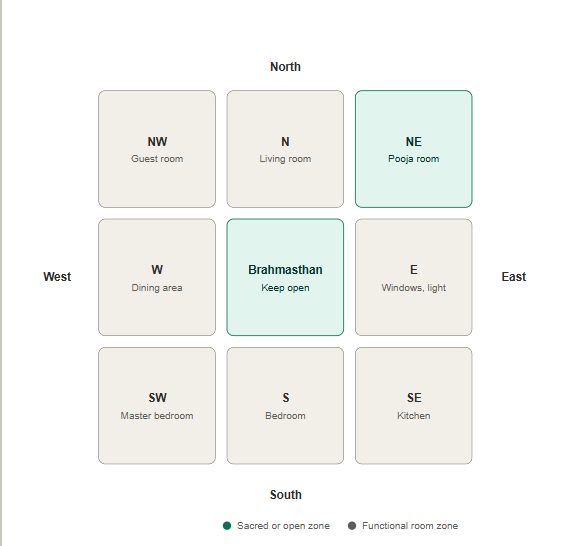
The main entrance is considered the point through which energy enters the home. North, East, and Northeast-facing doors are considered most favourable. Where the door’s direction can’t be changed, interior fixes matter: keep the entrance well-lit, clutter-free, and avoid placing shoe racks or a staircase directly opposite it.
Living Room
Ideally positioned in the North, East, or Northeast of the home. Seating should face East or North where possible. Heavy furniture works best along the South or West walls, leaving the Northeast corner — considered the most sacred zone, or Ishanya kon — light and open.
Kitchen
The Southeast (Agneya) corner is the traditional placement for the kitchen, aligned with the fire element. The cook should ideally face East while working at the stove, and the stove and sink should not sit directly adjacent to each other, since fire and water are considered opposing elements. For Kollam’s many renovated and modular kitchens, this is usually solved through appliance and platform layout rather than moving walls — something we cover in more depth in our modular kitchen design guide for Kollam homes.
Bedrooms
The master bedroom is best placed in the Southwest, considered the most stable direction for rest and stability. Beds should be positioned so the head points South or East while sleeping, and mirrors should never directly face the bed. Colour choice plays a bigger Vastu role here than most homeowners realise — muted, warm tones are generally preferred over sharp reds or blacks in a bedroom, a point we go into further in our bedroom colour trends guide.
Pooja Room
The Northeast corner is the most auspicious placement for a pooja room or altar, since it’s associated with divine energy and the water element. Idols or photographs should face East or West, never South, and the pooja space should be kept separate from the bedroom and bathroom where floor plans allow.
Bathrooms and Toilets
Best placed in the West or Northwest, and should be avoided in the Northeast at all costs, since this can disturb the home’s most sensitive zone. Interior fixes such as exhaust placement, tile tone, and keeping the door closed when not in use help offset a less-than-ideal bathroom location.
Staircase
Should ideally rise in a clockwise direction from South to North or West to East. A staircase directly facing the main door is considered to block incoming energy — a common issue in Kollam’s multi-storey homes that’s usually corrected through furniture placement or a decorative screen rather than structural change.
Vastu for Apartments and Flats in Kollam: What You Can Actually Control
Most Vastu content online assumes you’re building a house from scratch. But a growing share of Kollam and Kerala homeowners live in flats and apartments, where the building’s core structure — door direction, kitchen location, bathroom placement — is already fixed and can’t be altered. This is where Vastu-compliant interior design, rather than Vastu-compliant construction, becomes genuinely useful.
Practical, non-structural fixes we regularly apply for apartment clients:
- Colour correction — using wall colour to balance a direction’s element (cool blues and greens in the East/North, earthy tones in the South/West)
- Mirror placement — positioning mirrors on the North or East wall to amplify light and space without breaking Vastu principles
- Furniture zoning — using heavier furniture to “anchor” the Southwest and keeping the Northeast visually open, even in a compact flat
- Indoor plants and water elements — small additions like a tabletop fountain or money plant in the East, used to symbolically offset a fixed kitchen or bathroom position that can’t be moved
- Lighting design — brightening a Vastu-weak corner (like a Northeast kitchen) with layered lighting, since light itself is treated as a corrective element in Vastu
If you’re planning a flat interior in Kollam, this ties directly into the layout decisions we walk through in our premium apartment interior design guide.
Common Vastu Myths We Hear From Kollam Clients
“An imperfect direction means the house is unlivable.” Not true. Vastu offers remedies — colour, placement, mirrors, lighting — for almost every directional compromise. Very few homes are 100% Vastu-perfect, and that’s expected.
“Vastu and modern design can’t work together.” In practice, most Vastu principles — good natural light, uncluttered corners, functional zoning — align naturally with good modern design anyway. The two rarely conflict as much as homeowners assume.
“Vastu correction always means breaking walls.” Structural correction is the last resort, not the first step. The majority of Vastu concerns we handle at Nila Interiors are resolved through furniture placement, colour, and layout — not demolition.
How Nila Interiors Balances Vastu With Modern Kollam Homes
At Nila Interiors, we don’t treat Vastu as a separate add-on service — it’s factored into the same design conversation as layout, budget, and material selection, right from our first site visit. Our approach for Kollam clients typically includes:
- Reviewing the existing directional layout of the home or flat before finalising furniture and kitchen zoning
- Suggesting non-structural Vastu corrections through colour, lighting, and furniture placement wherever the building’s structure is fixed
- Balancing traditional Vastu preferences with contemporary, space-efficient design — especially important for smaller Kollam homes and apartments
- Working directly with the family’s preferences, since Vastu adherence in Kollam households often varies from strict to flexible
This is the same client-first approach behind our complete interior design cost guide for Kollam and our guide to hiring the right interior designer in Kollam — transparent, practical, and built around what Kollam homeowners actually ask for.
If you’re planning a new home or renovating an existing one, our team at Nila Interiors, Kollam can walk through your layout and suggest Vastu-conscious design choices that fit your space, budget, and beliefs — without forcing a one-size-fits-all rulebook onto your home.
Frequently Asked Questions
1. Is Vastu important for interior design, or only for house construction?
Both. Structural Vastu (plot shape, room placement) is decided during construction, but a significant part of Vastu balance — colour, furniture direction, mirror placement, lighting — is achieved during interior design, which is why it matters even for homeowners renovating an existing house.
2. Can a flat or apartment in Kollam be made Vastu-compliant if the kitchen or main door direction is fixed?
Yes, largely. Since the structure can’t be changed, Vastu-conscious interior designers use colour correction, furniture zoning, mirror placement, and lighting to offset a less-than-ideal direction. Full structural correction is rarely necessary.
3. Which is the best direction for the kitchen as per Vastu?
Southeast (Agneya) is traditionally considered ideal, since it aligns with the fire element. Where that isn’t possible, Northwest is considered the next-best alternative.
4. Does Nila Interiors offer Vastu consultation along with interior design in Kollam?
Yes. Our design team factors Vastu-conscious layout suggestions into the interior design process for both residential and commercial projects across Kollam, working alongside your preferences rather than imposing rigid rules.
5. Is it necessary to follow Vastu strictly for a modern home in Kollam?
No. Many Kollam families follow Vastu selectively — prioritising a few key zones like the pooja room, main entrance, or kitchen while staying flexible elsewhere. Our team designs around whatever level of Vastu adherence fits your family’s preference.
Looking for interior designers in Kollam who understand both modern design and traditional Vastu principles? Talk to Nila Interiors — Kollam’s trusted interior design team.